Skip to content
In stock Triamcinolone
Anti-inflammatory

Triamcinolone

Inflamed, itchy skin affected by eczema, dermatitis, or allergic irritation may require a topical corticosteroid to settle redness and discomfort. Triamcinolone contains triamcinolone acetonide 0.1%…

Guaranteed quality Original product
Delivery: from 4 days Discreet shipping
24/7 Support Always available
Active ingredient: Triamcinolone
Select pack Package Per unit Price
$ 2.81 $ 84.15
$ 2.31 $ 168.30 $ 138.38 Save 18%
$ 2.06 $ 252.45 $ 185.13 Save 27%
$ 1.85 $ 336.60 $ 222.53 Save 34%
$ 1.67 $ 504.90 $ 301.07 Save 40%
Best value Free Regular Delivery $ 1.50 $ 1,009.80 $ 540.43 Save 46%

Free delivery on orders from $ 374.00, free express delivery from $ 561.00

Secure payment methods:
VISA AMEX JCB DISCOVER

Inflamed, itchy skin affected by eczema, dermatitis, or allergic irritation may require a topical corticosteroid to settle redness and discomfort. Triamcinolone contains triamcinolone acetonide 0.1%, a corticosteroid cream that reduces inflammatory immune signals in affected skin.

Product information

Triamcinolone is a topical corticosteroid cream for inflammatory skin conditions that respond to steroid treatment. Its active substance, triamcinolone acetonide, acts inside skin cells through glucocorticoid receptors. The cream is intended for external skin use. It is not designed for eyes, the mouth, or internal use.

Directions for use

Use Triamcinolone only on the areas selected in the treatment plan. Wash hands before and after application unless the hands themselves are being treated. Let the cream absorb before applying a moisturiser to the same site.

When both a moisturiser and Triamcinolone are used on one area, separate them by about 20 to 30 minutes. Applying both together can dilute the steroid or spread it beyond the intended rash.

Individual treatment schedule

The amount per application and treatment schedule are set individually rather than being one fixed dose. Apply the prescribed amount to the affected skin at the prescribed frequency and for the prescribed course. A clinician may choose a shorter course for thin skin areas and a different schedule for thicker skin on the trunk or limbs.

Avoid covering treated skin with plastic wrap, tight dressings, or waterproof bandages unless this has been specifically prescribed. Occlusion can greatly increase the amount of corticosteroid that enters the skin.

Ingredients

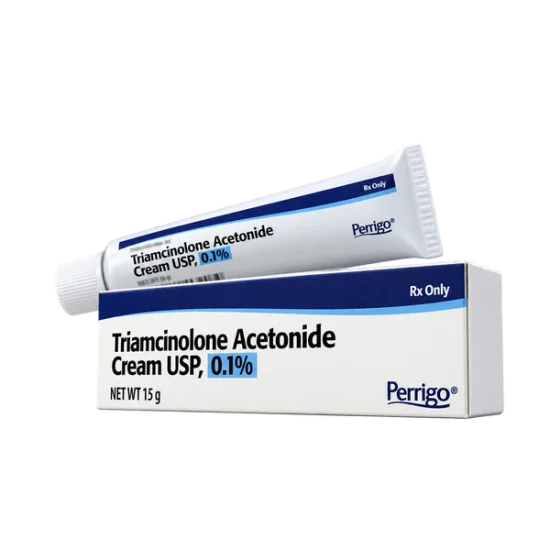
Triamcinolone is supplied here as a 0.1% cream in a 15 g pack. Cream vehicles spread easily, feel lighter than ointments, and are often preferred for moist, weeping, or hairy skin areas. Ointment bases are more occlusive and may suit very dry, fissured skin, yet they are not interchangeable with this cream without clinical advice.

Formulation feature Cream base Ointment base
Texture Light and easily spread Greasy and more occlusive
Usual skin fit Moist, inflamed, or hairy areas Very dry, scaly, or cracked areas
Absorption pattern Moderate skin contact Greater occlusion can increase absorption

The American Academy of Dermatology recommends topical corticosteroids as a core anti-inflammatory option for atopic dermatitis, with potency and duration matched to body site and flare severity [2].

How it affects the body

This reduces production of inflammatory messengers linked with redness, swelling, itching, and thickened skin. The benefit is local action. The cream is absorbed through the skin, so treating a small active area generally exposes the body to less corticosteroid than oral steroid treatment.

Therapeutic indications

Triamcinolone acetonide is often selected when a moisturiser alone has not controlled an inflammatory flare. It can be useful for limited areas of eczema, contact dermatitis, insect-bite reactions, and other steroid-responsive rashes when a clinician has identified inflammation as the main problem.

Itching may ease before redness fully fades. Thick, scaly skin can take longer to settle because inflammation is deeper within the skin barrier. A rash that becomes painful, warm, weepy, crusted, or rapidly spreading needs reassessment because infection can resemble an inflammatory flare.

The FDA classifies triamcinolone acetonide cream 0.1% among topical corticosteroid treatments for corticosteroid-responsive dermatoses [1].

Common mistakes

Several avoidable habits raise the chance of poor results or side effects:

  • Applying Triamcinolone to an undiagnosed ring-shaped or spreading rash that may be fungal.
  • Treating eyelids, facial skin, groin, or skin folds for longer than directed.
  • Covering the area with an airtight dressing to make the cream work faster.
  • Using the cream on cuts, ulcers, cold sores, or weeping lesions without assessing infection.
  • Stopping moisturiser care once the redness improves, allowing dryness to trigger another flare.
  • Sharing prescription steroid cream with another person whose rash may have a different cause.
  • Continuing treatment after the active rash has settled because mild colour changes remain.

Colour changes can persist after inflammation resolves. Steroid cream treats active inflammation; it does not instantly remove post-inflammatory pigment changes.

Reasons not to use it

Corticosteroids suppress visible inflammation, which can temporarily mask an untreated infection while the underlying cause progresses.

  • you have had an allergic reaction to triamcinolone acetonide, another corticosteroid, or a component of the cream;
  • the intended area has untreated bacterial, fungal, viral, or parasitic skin infection;
  • you have chickenpox, shingles, cold sores, or another active viral lesion at the application site;
  • the rash involves the eye itself or there is unexplained eye pain, vision change, or marked eyelid swelling;
  • the skin ulcer is deep, severely broken, or suspected to be infected without a treatment plan;
  • you have rosacea, acne, or perioral dermatitis in the area unless Triamcinolone has been specifically prescribed for that diagnosis.

Strong CYP3A4-inhibiting medicines, including ritonavir- or cobicistat-containing treatments, can still increase corticosteroid exposure when absorption is substantial. Tell the prescriber if such medicines are part of your regular treatment.

Unwanted effects

Most unwanted effects are local. Temporary stinging, burning, dryness, itching, or irritation can occur when cream is first applied, especially on inflamed or cracked skin. These symptoms may settle as the flare improves. Mild dryness may occur during treatment. Report severe or persistent reactions to the prescriber.

Longer or heavier use can cause skin thinning, stretch marks, easy bruising, altered pigmentation, prominent small blood vessels, folliculitis, or acne-like spots. Systemic corticosteroid effects are uncommon with small-area short-term use, though risk increases with extensive treatment, occlusive dressings, damaged skin, and use in children.

A burning sensation that lasts only briefly can occur on cracked eczema. Burning that intensifies after each application, or a rash that develops new blisters, may signal irritation or allergy rather than healing.

NICE advises matching topical steroid potency to eczema severity and body site, while monitoring for infection and adverse skin changes during treatment [3].

Comparison

Topical corticosteroids differ mainly in potency, vehicle, and the body site for which they are appropriate. Triamcinolone cream sits between mild hydrocortisone-type therapy and very potent topical steroids used for short, closely supervised courses. Prednisone is an oral corticosteroid and works throughout the body, so it has a different risk profile and is not a substitute for topical treatment of a localised rash.

Corticosteroid approach Relative intensity Typical clinical role
Triamcinolone acetonide 0.1% cream Medium topical potency Localised inflammatory rashes on suitable body skin
Fluocinonide topical Potent topical corticosteroid Resistant, thicker inflammatory plaques for limited courses
Clobetasol propionate 0.05% Very potent topical corticosteroid Severe, thick plaques under close clinical direction
Prednisone oral treatment Systemic corticosteroid More widespread or severe inflammatory disease when clinically indicated

Very potent topical corticosteroids can work quickly on thick plaques, yet their margin for error is narrower. Using a high-potency product on the face or skin folds can produce harm in a short period. Triamcinolone may offer a more suitable balance when a clinician considers medium potency appropriate for the affected site.

What doctors say

In clinical practice, prescribers focus less on the tube itself and more on the pattern of the rash. Location, thickness, infection signs, prior steroid exposure, and response to moisturising care all influence whether Triamcinolone is suitable.

Doctors often see treatment fail because the cream is used too sparingly during an active flare, then overused once the skin improves. Another familiar pattern is applying steroid cream to every itchy area without confirming that all rashes have the same cause. Fungal rashes, scabies, psoriasis, allergic dermatitis, and bacterial infection can all look inflamed, yet their treatment plans differ.

A useful treatment goal is specific: less itch, less redness, fewer cracks, and no spread of the affected patch. If those measures do not improve within the expected treatment period, changing the amount of cream without review is rarely the right next step.

What customers often ask

How long does one application of Triamcinolone keep working?

Triamcinolone begins acting in the skin after application, though visible improvement depends on the diagnosis, skin thickness, and severity of inflammation. The anti-inflammatory effect is designed to support the prescribed application schedule rather than repeated use whenever itching returns. FDA prescribing information published in 2024 describes topical corticosteroids as local treatments whose use should be limited to the needed area and duration [4]. If symptoms return before the next planned application, do not increase frequency without the prescriber’s direction.

Can I drink alcohol while using Triamcinolone cream?

Alcohol does not have a direct interaction with small-area topical Triamcinolone use because the treatment acts mainly in the skin. Alcohol can worsen flushing, dehydration, sleep quality, and scratching in some people with eczema or dermatitis. This practical issue matters more when alcohol is a personal trigger for skin flares. Medsafe’s medicine-safety approach in 2026 supports reporting unexpected reactions or suspected interactions through its established pharmacovigilance systems.

Can Triamcinolone be combined with antiviral medicines?

Most people using topical antiviral medicines do not have a direct medicine interaction with Triamcinolone cream. The key issue is the skin condition being treated: corticosteroid should not be applied over an active viral lesion, such as a cold sore or shingles rash, unless a clinician has made that plan. WHO guidance from 2023 on herpesvirus infections recognises that skin lesions require diagnosis-specific care rather than a one-treatment approach. Tell the prescriber about regular antivirals, immune-suppressing medicines, or HIV treatment before starting a corticosteroid course.

Is Triamcinolone suitable for older adults?

Older adults can use topical Triamcinolone when it is clinically appropriate, though ageing skin is thinner and may bruise or tear more easily. A short, targeted course on the correct area is generally preferable to broad, prolonged application. Skin infection, diabetes, circulation problems, and multiple medicines can complicate a rash and should shape the treatment plan. EMA safety principles published in 2023 for corticosteroids support using the lowest suitable exposure for the shortest needed period.

What happens if I stop Triamcinolone, and does it need tapering?

Short, localised courses of topical Triamcinolone are often stopped when the prescribed course ends or the inflammation has settled. Tapering may be advised after prolonged treatment, frequent repeated courses, or use over large areas because the skin condition can rebound if treatment is withdrawn abruptly. The plan depends on where the cream was used and how long treatment continued. NICE guidance published in 2023 supports confirming that the cause is the same before restarting leftover cream for a new rash.

Do you offer anonymous delivery?

Your order will be securely packed and shipped within 24 hours. This is exactly what your package will look like (images of an actual item sent). It has the size and look of a regular private letter (24x11x0.7 cm) and its contents cannot be seen.

Comparison

Deflazacort

Active ingredient: Deflazacort
1mg 12mg 18mg 24mg 30mg 6mg
From $ 33.66
pills
3.5 (4)

Triamcinolone Current

Active ingredient: Triamcinolone
4mg
From $ 84.15
pills
4.2 (3)

How the medicines for Anti-inflammatory compare

How Buyers Rate Triamcinolone

Based on 3 reviews

Elaine, 63 Verified
Rating: 5 out of 5

I used Triamcinolone on a patch of eczema on my lower leg for the course I was given. The itch eased after a few days, and I found that using moisturiser later in the day stopped the skin feeling tight. I was careful not to keep applying it once the redness had gone.

Hamilton The course I was given 20 Oct 2026
Darren, 33 Verified
Rating: 3.5 out of 5

I had a red itchy area after changing cleaning products at work. The cream helped the itch settle within the first week, but I made the mistake of putting it on straight after moisturiser at first. Separating the two applications made it much easier to apply only where I needed it.

Nelson During the first week 2 Nov 2026
Amanda, 28 Verified
Rating: 4 out of 5

The cream reduced the redness on my hands, though the first couple of applications stung because the skin was cracked. I stopped using it when the area became sore and weepy rather than improving, and the cause turned out to need different treatment.

New Plymouth The first couple of applications 15 Nov 2026

Sources

  1. U.S. Food and Drug Administration (2024). Triamcinolone Acetonide Cream USP, 0.1%: Prescribing Information.
  2. American Academy of Dermatology (2023). Guidelines of care for the management of atopic dermatitis in adults with topical therapies.
  3. NICE (2023). Atopic eczema in under 12s: diagnosis and management.
  4. National Library of Medicine (2024). Triamcinolone Acetonide Cream: Drug Label Information.
Get our free app Shop faster and track your orders 3.9 · 414 reviews Install