The nausea eased within the first day and I could keep fluids down. I had a dry mouth, but it was manageable with water. I stopped once the short course ended.
Invercargill Two days 2 Nov 2026Motilium
Motilium contains domperidone, which helps coordinate stomach emptying and reduces signals that trigger nausea and vomiting. It is intended for adults with suitable short-term gastrointestinal…
Motilium contains domperidone, which helps coordinate stomach emptying and reduces signals that trigger nausea and vomiting. It is intended for adults with suitable short-term gastrointestinal symptoms when a clinician or pharmacist considers domperidone appropriate.
Product information
Motilium is an oral tablet containing domperidone, a dopamine-receptor antagonist with antiemetic activity.
Directions for use
The amount and frequency of Motilium depend on the reason for treatment, the patient’s age, kidney and liver function, interacting medicines, and cardiac history. The dose should be agreed with a doctor or pharmacist.
For adults for whom domperidone is considered suitable, regulatory guidance commonly uses the lowest effective dose for the shortest possible duration. How much to use and how often to take it depend on the purpose of treatment and should be agreed with a doctor or pharmacist. Treatment should remain short-term unless a clinician gives a specific reason for a different plan.
Practical administration points include:
- Take the tablet before meals if this is the agreed schedule.
- Space doses evenly when more than one daily dose has been prescribed.
- Swallow the tablet with water.
- Do not take extra tablets to compensate for vomiting or a missed dose.
- If a dose is missed, take it when remembered unless the next dose is close; skip the missed dose rather than doubling.
- Do not continue treatment beyond the agreed duration without reassessment.
- Do not combine it with other domperidone-containing products.
A person with moderate or severe kidney impairment may require less frequent dosing. Liver disease can also alter suitability. Children, older adults, and people with low body weight need individual assessment because risk is not determined by symptom severity alone.
Ingredients
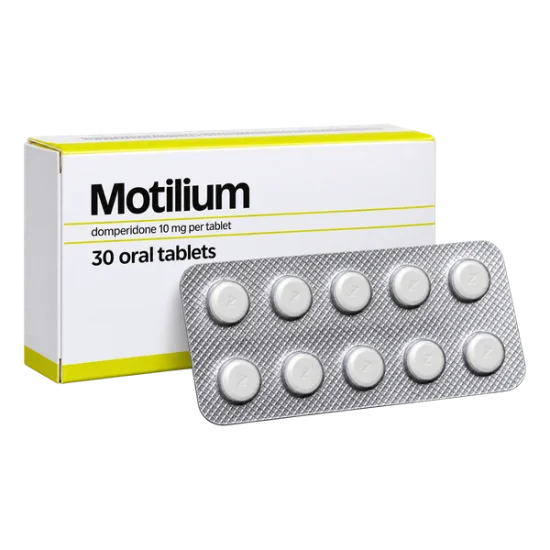
The product contains domperidone, with 30 oral tablets in the supplied pack. Domperidone acts mainly outside the brain because it crosses the blood–brain barrier only to a limited extent.
As an antiemetic, domperidone can reduce nausea and vomiting. It also increases coordinated movement in the upper gastrointestinal tract, which may help food move from the stomach into the small intestine. Medsafe and the European Medicines Agency have placed clear limits on domperidone use because of dose-related cardiac risks [1].
Domperidone is not a general treatment for every cause of nausea. Symptoms caused by bowel obstruction, gastrointestinal bleeding, severe infection, migraine, pregnancy, medication toxicity, or a surgical condition require a different clinical assessment.
How it affects the body
Domperidone blocks dopamine D2 receptors in the gastrointestinal tract and in the area of the brainstem involved in vomiting signals. Reduced dopamine activity in the gut can improve coordinated upper-gastrointestinal movement and support gastric emptying. Reduced activity in the chemoreceptor trigger zone can lessen nausea and vomiting. These effects do not remove the underlying cause of nausea or vomiting.
The medicine has two clinically relevant actions:
- It supports gastric motility by increasing coordinated contractions in the upper digestive tract.
- It reduces stimulation of vomiting pathways linked to dopamine receptors.
- It has limited penetration into the central nervous system compared with some older dopamine-blocking medicines.
- It can raise prolactin because dopamine normally suppresses prolactin release.
Therapeutic indications
Motilium may be used for short-term relief of nausea and vomiting when the expected benefit outweighs the cardiac and neurological risks. It should not be used simply to treat fullness, bloating, reflux, or abdominal discomfort without a clear clinical reason. The EMA restriction on duration and dose reflects evidence linking domperidone with QT prolongation, serious ventricular arrhythmias, and sudden cardiac death in susceptible patients [2].
The effect is not the same as sedation. Domperidone does not treat the underlying infection, food poisoning, inflammatory bowel disease, obstruction, or medication reaction causing the symptom.
Common mistakes
Several everyday mistakes can reduce benefit or increase risk:
- Taking extra tablets after vomiting.
- Continuing treatment because nausea returns, without reassessing the cause.
- Using Motilium for bloating or reflux when no motility-related indication has been established.
- Combining it with another domperidone product.
- Taking it alongside a new antibiotic or antifungal without checking for interactions.
- Ignoring palpitations, dizziness, or fainting because the original complaint was digestive.
- Taking doses after meals when the agreed instructions specify before meals.
- Assuming a previous uncomplicated course means future cardiac risk is absent.
- Crushing tablets when swallowing is difficult instead of seeking a suitable formulation.
- Treating dehydration only with antiemetic tablets.
A missed dose does not usually justify a double dose. If vomiting, diarrhoea, fever, or poor fluid intake continues, dehydration and electrolyte imbalance can become more important than the original nausea.
One common misconception is that a medicine that improves stomach movement is suitable for all abdominal discomfort. It is not. Severe pain, a distended abdomen, inability to pass stool or gas, or blood in vomit needs urgent clinical evaluation.
Reasons not to use it
Motilium is not suitable for everyone. It should not be used in people with:
- A known allergy to domperidone or an excipient in the tablet.
- Prolonged QT interval or a known heart-rhythm disorder.
- Significant heart disease, including certain conduction abnormalities.
- Moderate or severe liver impairment.
- Low potassium or low magnesium that has not been corrected.
- Gastrointestinal bleeding, perforation, or mechanical obstruction.
- A condition where stimulating gastrointestinal movement could worsen the problem.
- Concomitant treatment with medicines that strongly inhibit CYP3A4 or prolong the QT interval.
Examples of interacting medicines include certain macrolide antibiotics, azole antifungals, some antiarrhythmics, and other medicines known to affect cardiac repolarisation. The exact interaction depends on the drug, dose, and patient factors. A medication review should include prescribed medicines, over-the-counter treatments, and supplements.
When this is not for you
Tell the prescriber or pharmacist about heart rhythm problems, previous fainting, kidney disease, liver disease, electrolyte abnormalities, pregnancy, breastfeeding, or a history of gastrointestinal bleeding. Breastfeeding also deserves specific discussion because domperidone can increase prolactin and may pass into breast milk.
Motilium is not for you if you have a known prolonged QT interval, clinically significant heart disease, moderate or severe liver disease, or a suspected bowel obstruction. The New Zealand product information gives cardiac and gastrointestinal contraindications that should be applied before treatment begins [3].
Unwanted effects
Domperidone is often tolerated for short courses, but its safety profile is not risk-free. Common or recognised adverse effects include dry mouth, headache, abdominal discomfort, diarrhoea, and changes in bowel movement. Increased prolactin can cause breast tenderness, breast enlargement, milk secretion, menstrual changes, or sexual-function changes.
Cardiac effects require more attention than ordinary digestive side effects. Domperidone can prolong the QT interval, a measurement of electrical recovery between heartbeats. This may trigger an abnormal rhythm called torsades de pointes, which can cause palpitations, dizziness, fainting, or cardiac arrest. Risk rises with excessive dosing, prolonged use, older age, electrolyte disturbances, heart disease, and medicines that inhibit domperidone metabolism or also prolong the QT interval.
Stop taking the medicine and seek urgent medical help for:
- Fainting or near-fainting.
- A fast, irregular, or forceful heartbeat.
- Chest pain or severe breathlessness.
- Seizure.
- Swelling of the face, lips, tongue, or throat.
- Severe rash, blistering, or difficulty breathing.
Mild dry mouth can improve with regular sips of water and good oral hygiene. Diarrhoea or abdominal cramping should not be managed by repeatedly increasing the dose. If symptoms persist, the underlying cause needs review.
One practical detail is easy to miss: vomiting itself can cause low potassium or magnesium, and those electrolyte changes can increase arrhythmia risk. Another is that domperidone-related breast symptoms can occur because of raised prolactin, even when the medicine is taken for only a short period.
Comparison
Generic domperidone and Motilium contain the same active substance when supplied at the same strength. The pharmacological class and expected mechanism are therefore the same. Differences may involve inactive ingredients, tablet appearance, manufacturer, and approved product information.
| Feature | Motilium | Generic domperidone |
|---|---|---|
| Active ingredient | Domperidone | Domperidone |
| Pharmacological class | Dopamine-receptor antagonist; antiemetic | Dopamine-receptor antagonist; antiemetic |
| Clinical principle | Supports gastric motility and reduces nausea signals | Supports gastric motility and reduces nausea signals |
A generic product is assessed against the relevant pharmaceutical and bioequivalence requirements for its market. Therapeutic interchangeability depends on the specific authorised product, strength, patient factors, and the prescriber’s or pharmacist’s decision. The brand name does not remove domperidone’s cardiac precautions.
The practical choice is therefore driven by the active ingredient, strength, formulation, treatment purpose, and suitability for the individual patient. Patients should not combine Motilium with another domperidone product, since doing so can unintentionally increase the total daily dose.
What doctors say
In clinical practice, doctors generally treat domperidone as a short-term symptom medicine rather than a solution for chronic digestive disease. The decision involves three questions: what is causing the nausea, whether domperidone is likely to help that cause, and whether the patient has cardiac or interaction risks.
A clinician may choose another approach when nausea results from migraine, pregnancy, postoperative illness, medication toxicity, vestibular disease, or a serious abdominal condition. Domperidone may reduce vomiting while leaving the underlying illness untreated, so symptom improvement should not be mistaken for diagnosis.
The benefit-risk balance is more favourable when the course is short, the dose is low, and there are no cardiac risk factors. It becomes less favourable when symptoms continue for several days, when the patient needs repeated courses, or when the medicine is combined with interacting treatments.
The WHO’s 2024 model guidance on essential medicines supports careful selection of medicines according to indication, patient risk, and monitoring needs rather than symptom suppression alone [4]. Related guidance from NICE, the UK's Medicines and Healthcare products Regulatory Agency (MHRA), and the U.S. Food and Drug Administration (FDA) also informs medicine-safety assessment. That principle fits domperidone well: a lower dose and shorter course are preferable when they provide adequate relief.
What customers often ask
What is the best time of day to take Motilium?
The usual timing is before meals, with the exact schedule agreed with a doctor or pharmacist. Taking domperidone before food may support more predictable absorption and gastrointestinal action. The medicine should not be taken more often than directed. Medsafe’s 2025 medicine-safety information continues to emphasise the lowest effective dose and short treatment duration for domperidone.
What should I do if the expected result does not come?
Do not keep increasing the dose when nausea or vomiting continues. Persistent symptoms may indicate dehydration, infection, obstruction, medication toxicity, or another condition that domperidone cannot treat. Seek prompt medical assessment if symptoms are severe, last beyond the agreed treatment period, or occur with abdominal swelling, blood, faintness, or chest symptoms. The EMA’s 2014 domperidone restrictions are based on benefit-risk assessment, not on escalating treatment when the initial response is poor.
Which concrete condition rules Motilium out?
A prolonged QT interval or clinically significant heart-rhythm disorder rules out domperidone use. Moderate or severe liver impairment, low potassium or magnesium, gastrointestinal bleeding, perforation, and mechanical obstruction are also important exclusions. Medicines that strongly inhibit CYP3A4 or prolong the QT interval can create the same concern. Medsafe’s 2025 New Zealand product information identifies these contraindications and interaction risks.
What should I discuss with a doctor before starting Motilium?
Discuss heart disease, fainting, irregular heartbeat, liver or kidney disease, electrolyte problems, pregnancy, breastfeeding, and every medicine or supplement you use. Include recent antibiotics and antifungals, because some can alter domperidone exposure or cardiac electrical activity. Mention whether the nausea is associated with severe pain, a swollen abdomen, blood, fever, or inability to keep fluids down. The EMA’s 2014 safety review remains a key reference for this pre-treatment assessment.
Which habits can help or hinder the result?
Small, frequent sips of oral fluid can help reduce dehydration during vomiting, while alcohol and heavy meals may worsen gastrointestinal symptoms. Rest is useful during an acute illness, but antiemetic treatment should not replace evaluation when vomiting persists. Avoid strenuous exercise if you are dehydrated, dizzy, or unable to maintain fluids. WHO guidance published in 2024 supports fluid replacement and assessment of the underlying illness alongside symptom management.
Do you offer anonymous delivery?
Your order will be securely packed and shipped within 24 hours. This is exactly what your package will look like (images of an actual item sent). It has the size and look of a regular private letter (24x11x0.7 cm) and its contents cannot be seen.
How Buyers Rate Motilium
Based on 4 reviews
It reduced the vomiting, which helped me drink again. I was uneasy about the heart warnings because I already had blood-pressure treatment, so I arranged a medication review before taking another dose.
Auckland Two days 8 Nov 2026The first tablets helped, but the symptoms came back after the course. I also noticed abdominal cramping. The medicine was not the answer to the recurring problem, and further assessment was more useful.
Dunedin Two days 12 Oct 2026I took it before food as advised and felt better that evening. I nearly repeated a dose after being sick, but checked first and avoided doubling it. That was useful because the timing of the vomiting made absorption uncertain.
Blenheim Two days 21 Oct 2026Sources
- Medsafe (2025). New Zealand product information for Motilium and domperidone-containing medicines.
- European Medicines Agency (2014). CMDh confirms recommendations on restricting the use of domperidone.
- Medsafe (2025). Data Sheet: Motilium Tablets.
- World Health Organization (2024). WHO Model List of Essential Medicines.